Wednesday, 12 February 2014

The Maasai Shuka - warm, bright, colourful & solid!

Maasai shuka is a protective and decorative fabric made of hand woven cotton, belonging to Kenya. The Maasai (sometimes spelled "Masai" or "Masaai") are a nilotic ethnic group of semi-nomadic people inhabiting Kenya and northern Tanzania. They are among the best known local populations due to their residence near the many game parks of Southeast Africa, and their distinctive customs and dress.


The main garment worn by the Maasai is the shuka, which is a basic piece of fabric that can be worn in a variety of ways, depending on the personal style of the wearer. It was initially made out of animal skins, mostly cowhide but never elephant skin, but cotton is now the main material. The fabric is rubbed with color or dye to make it red, becoming a sort of camouflage with the red dirt of that part of Africa. In the dry grass plains the shuka can be white to camouflage with the grain

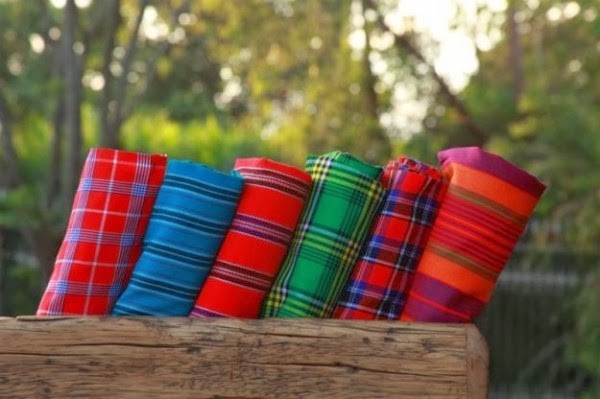


In the present time, Shuka woven in bright colors and plaid, is an accessory used in fashion for men and women. It is a beautiful example of African handicrafts, and always woven in vivid red by blending with black, blue or another main colour. It is also used as safari blanket due to the feature of keeping warm and is used as bath towel, scarf or home decoration accessory. 

Top designer Louis Vuitton has used Shuka in today's fashion and it is a marvel of creation!


Who would have guessed such a beauty from Africa would be hitting the world by storm! 
Africa is here! 

xoxo


.

The Chitenje of East Africa

The most commonly worn item of clothing by women in Malawi is the Chitenje (also known as a Kitenge in Tanzania and Kenya). Chitenji is a type of colorful, patterned cotton fabric that is common in many African countries like Malawi and Zambia.  Locally, chitenji is used for everything from making clothing, to wrapping skirts, to carrying infants.  It is sold by unit length in shops or sizable open markets.  The types of patterns that one can find on pieces of chitenji are extremely numerous meaning that you rarely see the exact same pattern twice.  


A chitenje is a rectangle of fabric (generally 2 x 1 metres) worn by women around the waist or chest. Chintenjes are an everyday piece of clothing. They are very often covered with a great variety of pictures, colors, patterns and usually include slogans, sometimes political slogans


The chitenje is generally wrapped around the waist and tied as you would tie a towel or sarong. Normally clothing (certainly underwear) is worn under the chitenje and this can cover up slightly shabby clothes with the chitenje's multi-coloured fabric


Chitenje's can be worn around the head as well, wrapped in a similar way to a head towel, and is used for decoration or to cover any hair-dos that may be in progress. It is also a very useful cushion for carrying...well anything that can be carried on the head!

A chitenje also makes an incredibly useful custom sling for a baby, and is either constructed so the baby can hang at the front, or slung over the back, with legs tucked around the side of the mum. Some of the more enterprising mothers are also able to breastfeed while the child is in the sling - allowing hands to be free for other, more imporant tasks!


Like heritage, African fabrics have been around for ages and will continue to be versatile like the Chitenje! 

xoxo


Wednesday, 29 January 2014

The modernisation of the Kaftan!


The kaftan or caftan is a simple garment that has been worn for thousands of years by both men and women. Kaftans can be plain, striped, or decorated - the rustic garment of a peasant, or a magnificent robe fit for a sultan. Kaftans trace their history back to the middle-easten countries. They have been worn for centuries and evolved over time.
 

Long associated with Islamic culture, the kaftan became popular in the West during the late 1960's and 70's when interest in comfortable clothing and ethnic styles made it a popular Bohemian style and an icon of the hippie movement.


The Western concept of the kaftan has come to describe a garment that is basically a large, rectangular piece of fabric, folded with a neck hole in the center, and stitching up the sides, leaving room for arms. Necklines can be squared, rounded, or V-neck. The V neck variety often features decorated or embroidered edging similar to a dashiki. Kaftans can be button fronted, belted, or drawn at or above the waist with a drawstring.


Today, the kaftan is back in a big way, popping up at Fashion Weeks and offering men & women comfort, modesty, and glamor.
 
xoxo


Friday, 24 January 2014

The summer maxi dress - gorgeous african fashion!

Afrokulcha's maxi dress has hit the fashion world by storm. It is chic, it is playful but serious and it is casual & smart at the same time!


Need I say more??
 
 
xoxo

Thursday, 23 January 2014

The beautiful South African sishweshwe fabric!

The formal name for "shweshwe" is ‘Indigo-dyed discharge printed fabric’. Historians claim that indigo cloth arrived in Africa nearly more than 2000 years ago, used as trade goods by the Arabs and Indians. But it really took off in South Africa when German settlers introduced it to the Xhosa people in the mid-1800s.

 
Shweshwe is a stiff cotton fabric that initially came from India and was heavily starched to fight off the damp in the ships’ storage compartments as it crossed the ocean to the Eastern Cape. Xhosa women took a look at these wondrous bolts of cloth, fell in love with the shweshwe fabric and made it their own.

Described as the denim of South Africa, shweshwe, the pure cotton fabric in multiple patterns and colours produced exclusively in the Eastern Cape province, is worn by women in every cranny of the country.


South African jewel is certainly taking over the world!
 
xoxo


The Fabulous West African Gele!

What is a "Gele"? Gele pronounced "gaye lay" is an African head wrap/head-tie that has its roots in the Yoruba tribe in Nigeria, West Africa. This female head wrap, usually worn at occasions such as weddings, is used specifically as an ornamental head covering or fashion accessory.


A "Gele" is a flat piece of fabric. Not just any kind of fabric but typically Aso Oke (Jean-like fabric), Brocade (Starched Cotton fabric), African Print, Paper-like fabric with plain or bold patterns, Damask (heavily patterned Paper-like, Velvet-like fabric), wrapped by hand to form a hat-like looking structure!


The fabric can vary in texture and length. To make the "gele"  look great, it needs to have a very strong base.

Africans looking fabulous! Don't you just agree?
 
xoxo

Thursday, 14 November 2013

Kente Cloth - The pride of Africa

"KENTE" is a brilliantly colourful fabric, entirely hand-woven from Ghana. The brilliant colours and intricate designs associated with Kente have definitely made this fabric the best known of all Ghanaian, and perhaps even all West African, textiles. Every design has a story with a proverbial meaning, giving each cloth its own distinction.

 
In its cultural context of use, "KENTE" is more than just a fabric. Like most of Africa's visual art forms, Kente is a visual representation of history, philosophy, ethics, oral literature, religious belief, social values and political thought. Originally, its use was reserved for Royalty and limited to special social and sacred functions!


There are over 300 different types of KENTE cloth designs, each with its name & meaning. Each cloth design comes with numerous variations-in colour. There are gender differences in colour preferences, dictated by tradition, individual aesthetic taste and by spirit of the occasion!


You have to admit, this is by far, one of the best creations Africa must be proud of.
 
xoxo